
Why Free Slot Demos Don’t Tell You How a Real-Money Session Will Feel

Free slot demos are useful for learning how a game works, but they are not an accurate simulation of gambling with real money. The reels, bonus rounds and advertised return-to-player rate may be identical, yet removing financial risk changes how players respond to every outcome.
People browsing looking for more free slots to play for fun can use demos to compare themes, controls and features without making a deposit. What they cannot test is how the same game feels when every spin affects a real balance.
Virtual Credits Remove the Cost of Every Decision
A demo balance might begin at C$10,000, encouraging players to select stakes they would never consider with money of their own. Losing C$100 in virtual credits has no effect on their finances, while losing the same amount from a genuine deposit could change their behaviour immediately.
This affects both betting and persistence. A player who continues after 100 unsuccessful demo spins may stop much earlier when each spin costs C$1. At that stake, 100 spins represent C$100 in total turnover, even if occasional prizes extend the session.
Demo play can consequently reveal whether a game is entertaining, but it says little about the decisions a player will make under financial pressure.
RTP Does Not Predict a Short Session
Return to player is one of the most frequently misunderstood slot statistics. A game with 96% RTP is mathematically designed to return C$96 for every C$100 wagered over an extremely large sample of play. It does not mean somebody depositing C$100 should expect to leave with C$96.
The theoretical house edge in that example is 4%. If C$500 is wagered during a session, the mathematical expected loss is C$20. However, the actual result could be a large win, a smaller loss or the entire bankroll disappearing.
Even extensive testing can produce results that differ from the advertised rate. Regulatory guidance has shown that a slot designed with an RTP of 91.68% could record an actual return between approximately 89.93% and 93.43% after 400,000 games and still fall within an acceptable statistical range.
A demo session containing a few hundred spins is therefore far too short to establish how generously a slot will perform later.
Volatility Can Empty Two Identical Bankrolls Differently
RTP describes the average proportion returned, while volatility describes how that return is distributed.
A low-volatility slot may generate frequent prizes of less than five times the stake. A high-volatility title may produce long stretches with few meaningful returns before awarding a rare bonus or large multiplier. Two games can both advertise a 96% RTP while creating completely different session results.
Suppose two players each begin with C$50 and stake C$1 per spin. One could complete hundreds of spins because regular small prizes repeatedly restore part of the balance. The other could lose the full C$50 quickly on a more volatile game. Neither result proves that the RTP is incorrect.
Demos help identify whether a game feels volatile, but a fortunate sample can disguise how severe its losing sequences can become.
A Demo Bonus Round Proves Nothing About the Next Session
Players sometimes use demos to estimate how frequently free spins or bonus rounds appear. This becomes misleading when a feature arrives unusually early.
Triggering three bonuses within 200 demo spins does not mean a bonus should appear every 67 spins. Unless the provider publishes the feature frequency, the player does not know whether that result was typical or exceptional.
Each spin is normally determined independently by a random number generator. A game does not remember that a player experienced a poor demo session, nor does it become “due” to award a bonus after an extended losing sequence.
Small Payouts Can Still Be Net Losses
Modern multiline slots frequently return less than the original stake. A player who wagers C$2 and receives C$0.80 has not won C$0.80 overall. The spin produced a net loss of C$1.20.
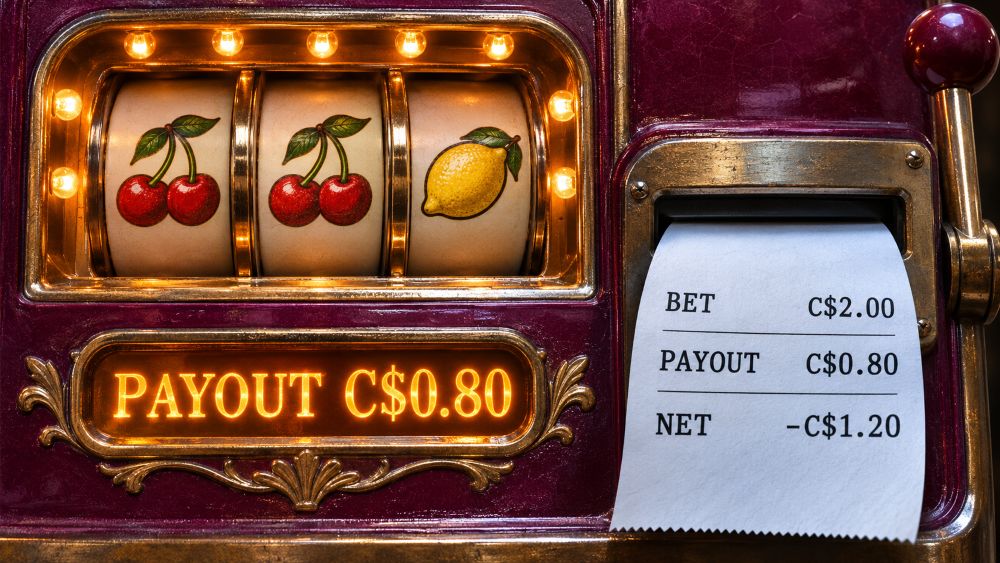
These outcomes are sometimes accompanied by animation or sound, making them feel more positive than a complete loss. Research covering 42,669 players and 17 million slot plays found that sequences of these partial returns could affect both subsequent bet size and playing speed.
Virtual balances make this distinction easy to overlook. With real money, repeated partial returns can steadily reduce a bankroll while creating the impression that the game is paying regularly.
Real Play Adds Conditions That Demos Exclude
Demo games generally sit outside the practical conditions attached to casino accounts. A real-money session may involve deposit limits, identity checks, withdrawal processing, currency conversion or bonus terms.
If a player accepts a C$100 bonus with a 20-times wagering requirement, for example, that could create C$2,000 in required turnover before associated winnings become withdrawable. Game weighting, maximum-bet rules and expiry periods may also apply.
The real-money version should also be checked independently because the same slot can sometimes be offered in different approved RTP configurations. A demonstration hosted on one site may not necessarily use the exact configuration available elsewhere.
Demos Are Testing Tools, Not Forecasting Tools
Free slots are valuable when used for the right purpose. They can show whether the controls are clear, whether the paytable is understandable and whether features such as cascading reels, expanding symbols or free spins are enjoyable.
They cannot estimate an individual player’s likely return, establish a reliable bonus frequency or reproduce the emotional impact of losing real money.
The sensible dividing line is simple: use demo mode to judge the product, not its profitability. A free slot can demonstrate how a game operates, but only a financial stake creates the pressure, caution and emotional responses that define a real-money session.